As the consensus on net zero 2050 has broken, an impassioned debate has broken out, with three dominant narratives:
- Abandon net zero – The cure is worse than the disease (e.g. Reform.)
- Accelerate renewables – Gas as the price-setting culprit and calling for rapid deployment of clean energy (e.g. Ed Miliband )
- Switch to nuclear – Renewables are still too costly and nuclear offers a cheaper path to decarbonisation (e.g. Kathryn Porter ).
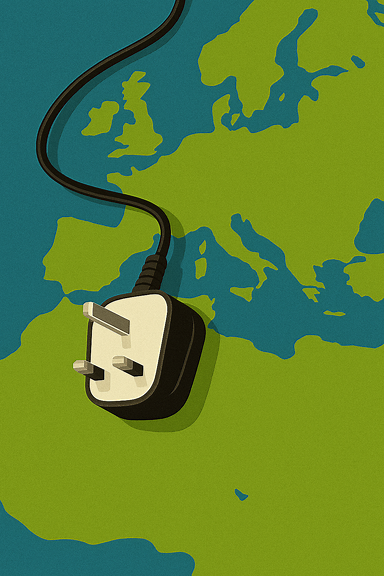
Each perspective has some merit. Yet, all overlook the most transformative opportunity / inevitability: directly connecting to ultra-low-cost solar power generated in vast quantities in the tropics. This is not a distant dream—it is an achievable and can dramatically lower electricity prices while accelerating decarbonisation. But to realise it, we must embrace a bold shift in thinking. It’s time to look beyond our borders, reimagine our infrastructure, and plug into a truly global energy system.
Until recently, there was near-universal agreement on the UK’s net zero 2050 target and the energy system required to achieve it. The plan was straightforward: electrify demand, gradually phase out gas-fired generation, and transition towards nuclear, wind, solar (and possibly biomass), supported by a mix of batteries, other storage technologies, demand-side management, interconnectors, and reserve generation to balance supply and demand.
That consensus has gone. Rising energy prices have inflicted damage on both industry and households, and the UK now faces some of the highest electricity costs in the world. The Conservative Party is considering scrapping the net zero target to mitigate this impact, while Reform UK has already committed to doing so. Labour remains committed to the target, arguing that the problem lies not in the transition itself, but in the slow pace.
What made me want to write is the parochial nature of the current debate. Politicians and commentators have formed into three camps—each overlooking a fourth, transformative opportunity: tapping into ultra-cheap solar power from the tropics.
The positions are:
1. Abandon Net Zero 2050
This camp ranges from outright climate sceptics to those who accept climate change is an issue but believe it’s overstated or that the UK’s contribution is negligible. Their argument is that renewables are driving up energy costs, harming industry, and delivering minimal climate benefits. They contend that, after decades of subsidies, renewables should now be commercially viable, if they ever are going to be.
There is some merit to this view. UK energy prices have risen faster than in many other countries, even before the war in Ukraine. Levies such as ROCs, FiTs, and CFDs have undeniably increased electricity bills. Energy-intensive industries are struggling, and households are poorer.
This perspective misses two critical points, however. First, most people agree it is urgent that we reduce greenhouse gas emissions. Second, fossil fuels are nearing their endgame,, see below. The future is renewable, we must ensure we don’t discard the solution in our frustration with the transition.
2. Accelerate Renewables
Ed Miliband argues that gas price volatility—due to market design where gas often sets electricity prices—is the root cause of high bills. His Clean Power Plan 2030 aims to reduce gas generation to just 5% by 2030, with NESO claiming savings of £300 per household annually.
While it’s true that gas prices spiked post-Ukraine invasion, and long-term renewables may be cheaper, the £300 saving is largely attributed to improved energy efficiency, not lower prices. Moreover, even the most recent auctions show onshore wind and solar have only fallen to £75–£80/MWh—comparable to gas, but without accounting for intermittency costs. Offshore wind, central to the 2030 vision, presents a more complex picture. Prices fell dramatically in the 2010s, reaching a bid of £40/MWh in 2019 (2012 prices), but those projects were never built. Today, the government’s price cap for this year’s auction is £113/MWh—far above average gas prices. And we still need to pay for gas plants to remain on standby.
Locking in current renewable prices reduces volatility but locks in high prices and forfeits the benefits of open market prices. Open markets, (if we can get something like that in our energy market), are and will remain the most efficient mechanism for keeping prices low, overall.
3. Go Nuclear
The go nuclear perspective supports rapid decarbonisation but argues renewables remain too costly. They advocate for a major expansion of nuclear power, claiming that it is expensive only because our regulatory framework treats it unfairly. With standardised designs and rational risk assessments, they believe nuclear could be deployed affordably and safely, citing South Korea’s much lower costs as an example.
I agree that nuclear has been treated irrationally, and that past underinvestment has cost us dearly. Germany’s decision to shutter nuclear plants while retaining coal is baffling. But, nuclear is expensive in the UK now, and reaching South Korean cost levels would require systemic reform and decades of investment. It would also necessitate a centrally planned, long-term commitment, leaving us unable to change if the price reductions don’t come.
Most importantly, this view overlooks the fact that renewables are already incredibly cheap—just not in the UK. Which brings me to the the way forward which is not being discussed enough / at all…….
4. Plug into the World
Solar power in the tropics is now available for under £15/MWh, with prices continuing to fall. That’s roughly a quarter of what we can generate renewable electricity and cheaper than anything else in the world. The cheap price of solar in some places is often mentioned, but the profoundness of its impacts aren’t. This is partly because we are still labouring under the misconception that electricity must be locally generated. We are used to oil and gas trading at global and regional prices, but we don’t think of electricity this way.
Of course, we already have interconnectors with Ireland, Norway, France, and the Netherlands, but they account for less than 10% of our electricity demand and are seen more as balancing system. We aren’t thinking of tens or hundreds of cables as a mesh moving electricity north (and west and east) from the tropics. The proposed Xlinks project linking Moroccan solar and wind to the UK grid is a glimpse of what’s possible, but hasn’t opened our eyes to the big picture future of a global mesh of electrical cables.
That can and will change. It just needs a few cables to be connected and it will seem obvious, just as we think nothing of importing gas from Qatar and oil from Saudi Arabia. The cables will be expensive but have a lifetime of decades and losses look to be around 20% even over 3,000 miles. This shift could slash energy bills and allow our energy-intensive industries to compete globally.
Intermittency is a big issue, but solar from North Africa is highly predictable, and east-west connections could further smooth supply. Its production would more closely match our demand profiles, with a blend of batteries, our own local wind, nuclear and existing interconnectors doing the rest. For those that point out the risk of trusting our energy supply to other countries, we already do it, (as with so many other products), we just need to ensure diversity of supply.
The political challenge is formidable. Another part of the world can make the commodity of electricity at <25% the cost we can and we have to accept we are not going to be a clean energy superpower, at least in generation terms. That is OK, we aren’t a red wine superpower or coffee, or clothing, or grain……… We will still have some generation and be a significant player in terms of legals, equipment, technology, finance, AI, etc. We are also going to need a large amount of investment in transmission and distribution and balancing systems.
We have already seen the first example of political resistance, with an unwillingness by the government to discuss a CfD with the Xlinks project because, “the project does not align strategically with the government’s mission to build homegrown power here in the UK”. There may be specifics about the Xlinks project which aren’t right, what concerns me is that it is being refused because the energy isn’t coming from this country. We need to get over that.
What I am saying is not a distant fantasy—it’s an inevitable evolution. The price differential for tropical solar to anything else is too large. There is an opportunity for the UK to lead in this global energy transition, reducing energy prices and benefitting from being the leaders in a system that will eventually be global. The future is renewable, cheap and mostly solar, we just need to get the extension lead.


Leave a Reply